
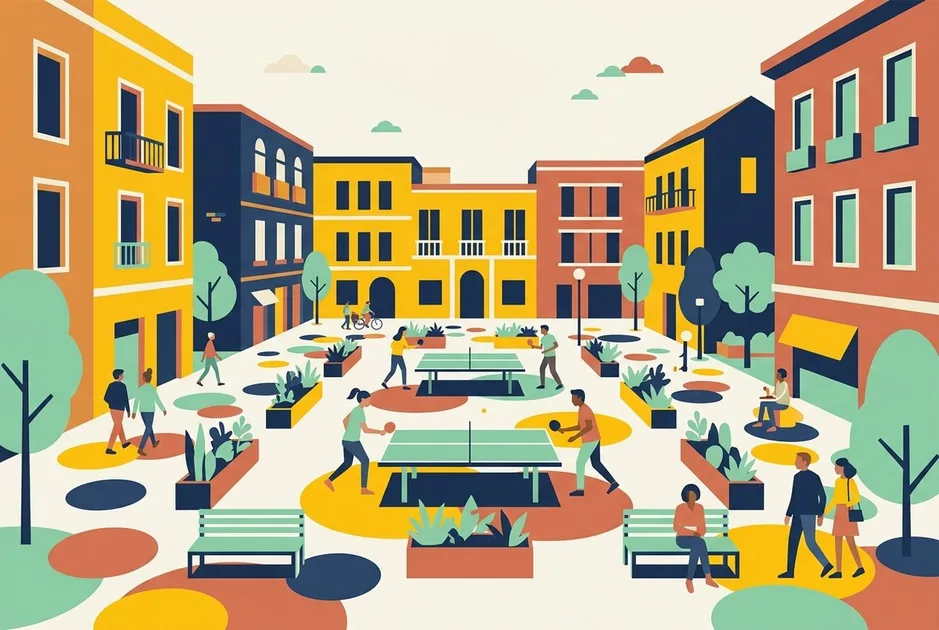
Milan's Open Squares (Piazze Aperte) program has become one of Europe's most successful examples of tactical urbanism, proving that transforming a car-dominated intersection into a comfortable public space does not require years of planning and multi-million-dollar budgets. This case demonstrates how, with the help of paint cans, potted trees, and street furniture, changes can be rapidly tested, returning streets to pedestrians and creating new community hubs in residential neighborhoods.
From Paved Intersections to Spaces for People
Historically, Milan faced a problem typical of many large cities: excessive car-centricity. A vast number of squares and intersections, especially outside the historic center, were used primarily as transit corridors for vehicles or chaotic parking lots. Residents of residential neighborhoods experienced a severe shortage of high-quality, safe places to relax, socialize, and walk with children. City authorities realized that the traditional approach to redevelopment—involving project design documentation, lengthy approval processes, and capital construction work—could not resolve the issue quickly enough.
Thus arose the idea of applying tactical urbanism methods at the level of citywide policy. Instead of waiting years for capital repair funding, the city decided to act immediately using the simplest and most accessible materials. The main goal was to rethink street geometry: narrowing the roadway in favor of pedestrians, creating pedestrian islands, and establishing new local centers where gray asphalt once dominated.
The Toolkit for Rapid Change: Paint, Planters, and Ping-Pong
The physical transformation of spaces within the Piazze Aperte framework looks vibrant and unconventional. The first step is always changing the road markings and painting the asphalt. In place of gray pavement, large colorful circles, geometric patterns, or bright stripes appear. This is not merely an aesthetic choice, but also a vital traffic-calming tool: visually altering the environment intuitively prompts drivers to reduce their speed and increases their attentiveness.
Next, the outlines of the new pedestrian zone are physically separated from vehicular traffic. Rather than using concrete barriers, large planters with greenery and trees are deployed, adding natural elements to the area. Street furniture is installed in the reclaimed space: affordable benches, picnic tables, bike racks, and frequently ping-pong tables or markings for children's games.
This approach embodies the "test before you build" philosophy. All changes are temporary and reversible. If a square's new configuration functions well, proves popular among locals, and does not cause traffic gridlock, it remains. Later, when funding becomes available, the city can carry out a permanent capital reconstruction of the site, replacing paint with paving stones and potted plants with trees planted directly in the ground. If an intervention proves unsuccessful, it can be quickly and cheaply adjusted or reverted to its original state. This significantly reduces resistance from conservative residents who often fear radical, irreversible changes.
Co-Organization and Community Engagement
The success of the Milanese experience lies not only in architectural solutions but also in its social component. The city administration does not simply arrive in a neighborhood to impose a new space; it turns local residents into full co-creators and stewards of these squares. The process of selecting locations for transformation often begins with gathering proposals directly from citizens, schools, local businesses, or community organizations.
A key instrument of engagement has been the so-called "collaboration pacts." These are formal yet non-bureaucratic agreements between the municipality and activists, local entrepreneurs, or homeowners' associations. Under these pacts, the community assumes partial responsibility for maintaining the new square: watering plants, basic cleaning, and organizing cultural events, neighborhood festivals, or markets.
This model of public space management fosters a strong sense of ownership. People stop viewing the square as impersonal municipal property and begin treating it as an extension of their own courtyard. Furthermore, the presence of active foot traffic in previously empty intersections stimulates local small businesses—cafés, bakeries, and shops—making neighborhoods even more vibrant and economically resilient.
Lessons for Ukrainian cities
- Testing solutions prior to capital investments. Using temporary materials (paint, street furniture) makes it possible to test hypotheses regarding traffic reorganization and the viability of pedestrian zones without the risk of spending millions on an unsuccessful capital project.
- Working effectively within limited budgets. Amid financial constraints, tactical urbanism allows for the rapid improvement of the urban environment, creating safe and comfortable spaces at minimal cost.
- Decentralizing civic life. Shifting the focus from the historic city center to residential districts helps equalize the quality of life across the city, providing residents of outlying neighborhoods with their own full-fledged community hubs.
- Sharing responsibility with the community. Involving local businesses and active citizens in space maintenance through formalized agreements reduces the burden on public utility services and cultivates a sense of stewardship among residents toward their infrastructure.